


Basic concepts
RATIONALE. Monitoring and evaluation. Basic concepts.
Identifying the potential environmental impacts of a project at early stage of the decision-making process is key to conduct thorough environmental assessments and to ensure environmental protection. To do so, it is important to review available environmental report and to involve all relevant stakeholders, including environmental and transport authorities and citizens, among other. Strategic Environmental Assessment (SEA) and Environmental Impact Assessment (EIA) are two succesive processes and tools to ensure that the environmental implications are taken into account before the decisions are made.
Even though evaluation is a pillar of the European environmental regulation, recent systematic reviews about the role of habitat and corridors for various animal taxa (Villemey et al., 2018; Ouédraogo et al., 2020), observed that a very small number of research studies have been built with a robust monitoring design, underlining among their recommendations for future research studies:
- Increase the study duration, the number of true spatial replicates and the spatial extent of the studies.
- Favour data collection before the intervention when studying the effect of management practices using, for example, BACI (before/after/control/intervention) or BAI (before/after/intervention) designs.
BACI approaches include time and impact factors, with a control site and a comparably impacted site, both represented by data before and after the impact. The BACI approach makes it possible to account for any natural or pre-existing differences between the sites, and thus to estimate the real effect of an impact variable between the control and the impacted site (Roedenbeck et al., 2007). However, such a BACI protocol needs to be designed with an optimal minimum number of sites, especially in large study areas. This means that the monitoring plan must be designed taking into consideration the size of the entire study area, as well as the time and resources required to monitor it effectively.
Monitoring and evaluation are activities undertaken to assess: i) the effects of a plan or project on biodiversity conservation targets; and ii) the effectiveness of mitigation measures or actions in reaching the goals for which they have been designed.
Although in practice ‘monitoring’ is used to refer to both monitoring and evaluation, these are different terms, and monitoring is always an activity within the evaluation process. Both are complementary and part of a continuous process (Figure 6.1.1).
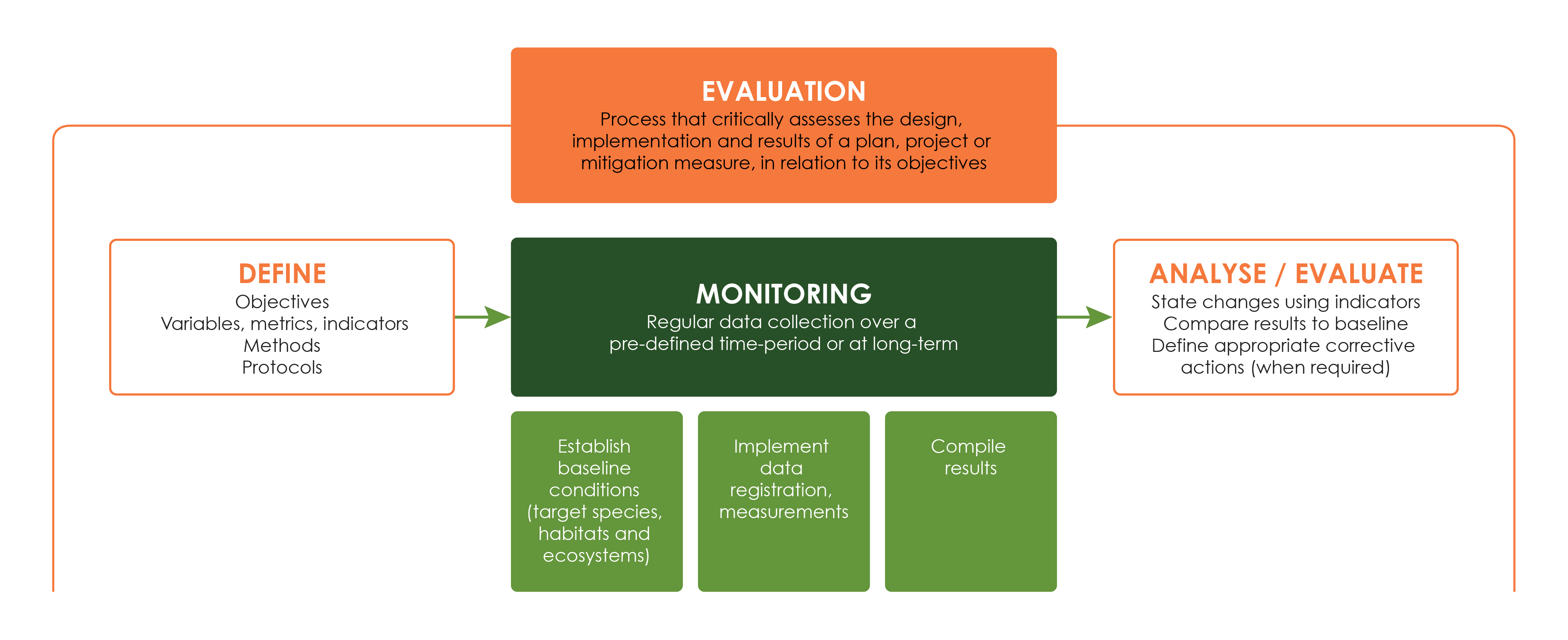
- Evaluation is a process that critically assesses the design, implementation and results of a plan, project or mitigation action, in relation to its objectives. It can be conducted both qualitatively and quantitatively, to determine the difference between actual and desired outcome. In transport ecology, the aim of this process is to check whether a project and the mitigation measures applied have met their objectives in terms of avoidance, reduction and compensation for impacts. A correct evaluation requires that mitigation objectives and their metrics are defined, and measured with an appropriate monitoring design. Evaluation is undertaken during the infrastructure operation phase and called in some countries ‘post-project analysis’. It requires data provided by monitoring (regular data collection over a pre-defined time-period or at long-term) and the application of a robust methodology design to collect unbiased data, where schemes developed in data collection and analyses are standardized and can be repeated.
- Monitoring is a process that combines repeated observations and measurements taken over time, usually to assess the temporal change in a parameter or in response to a disturbance/intervention or to quantify the performance of a plan, project or mitigation action against a set of predetermined indicators, criteria or objectives. The measurements to be taken and the methodology to be followed should be driven by the goal of the monitoring. In the framework of transport ecology, monitoring is a key tool which begins with the design of the monitoring plan. The first step in the design of a monitoring plan is the identification of clear monitoring goals based on target species, habitats and ecosystems which are expected to be affected.
This chapter focuses on monitoring and evaluation that are to be applied at the design, construction and operation phases and does not focus on the evaluation at strategic planning phase which must be also defined in association with SEA (see Chapter 2 – Policy, strategy and planning). About the maintenance phase, additional information regarding inspection and monitoring tasks to be undertaken can be found in Chapter 7 – Maintenance.
European legislation and country specific regulations, require an assessment of impacts on local biodiversity, and the design and application of measures to mitigate the impacts of transport infrastructure. These measures include actions to avoid, reduce or compensate for the impacts of any new infrastructure, and for upgrading and adaptation of existing infrastructure in some specific cases (see Chapter 3 – The mitigation hierarchy). Monitoring and evaluation should be defined in the initial steps of the transport infrastructure life cycle and should include a biodiversity baseline and specific measurements undertaken before the construction phase in association with EIA. They should continue during the construction and be maintained well after the initiation of the operation phase.
Monitoring associated to each evaluation (regardless of whether it is focused on the evaluation of infrastructure impacts or mitigation measures effectiveness) must be defined through a 4-step hierarchical but iterative approach, which ensures a consistency in the evaluation process. The examples below are focused on fauna crossing a road but may be equally applied to other mitigation scenarios and biodiversity targets (i.e., other habitats or ecosystems).
Step 1. Defining the evaluation objectives
Is the goal to evaluate an impact or the effectiveness of a mitigation measure? Depending on the answer, the objectives of the evaluation will vary. Objectives should always follow the SMART (Specific, Measurable, Achievable, Relevant, Time-bound) criteria. Some examples can be:
- Is the new project affecting the habitat use by a target species?
- Is the newly built wildlife passage mitigating roadkill? And the barrier effect?
Step 2. Defining the variables and indicators to undertake the evaluation
The variables and indicators selected will depend on the objectives established. In this step it should be defined what to monitor (variables) and what levels determine if the objectives are fulfilled or not (indicators). For example:
- Reduction of a 10% (indicator) in the abundance of individuals of the target species in the area (variable).
- Reduction of a 20% (indicator) in the time spent by the target species in the area (variable).
- Reduction of a 50% (indicator) in the number of AVC in relation to the population size (variable).
Step 3. Defining the method for recording the parameters defined in step 2
Once the variables and indicators are defined it is needed to decide which method can be applied to obtain the needed data. For example:
- Lineal transects to estimate population densities in the proximities of the road.
- Analyses of habitat use by radiotracking data.
- Road surveys to directly count dead animals on the road.
- Camera traps on wildlife passages to register animal crossing.
- Sampling target species tissue to evaluate genetic diversity from both sides of the infrastructure.
Step 4. Defining the appropriate scheme to implement the method proposed in step 3 for reaching the objective defined in 1
How the methods will be applied to guarantee we collect appropriate measurements and solid results? For example, define:
- Number of lineal transects required.
- Frequency of road mortality surveys to be conducted.
- Number, location of camera traps required and survey duration.
- Number of DNA samples required to characterise populations and identify differences.
If any factors such as practical feasibility, societal and governmental support, or available budget leads to a dead-end, the process should come back to the upper rank in the process hierarchy (i.e., if no answer can be found at step 3, a new branch of step 2 should be explored). This process can lead to an adaptation in the evaluation objectives.